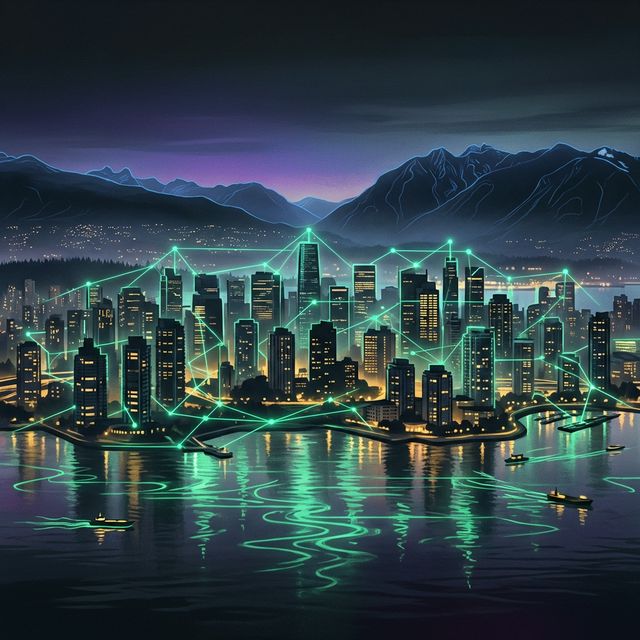
Vancouver doesn't show up on the usual "top startup cities" lists. That's not a bug — it's a feature. The builders who are choosing Vancouver aren't optimizing for hype. They're optimizing for focus.
Something is happening in this city that looks different from the Bay Area playbook. It's quieter, more deliberate, and — we'd argue — more sustainable. Here's what we're seeing from inside the community.
The Anti-Hype Ecosystem
Silicon Valley runs on a specific fuel: venture capital, FOMO, and the constant pressure to scale. That engine produced some of the most important companies in history. It also produced a culture where "shipping" often means "raising a Series A" and success is measured in headcount, not customers.
Vancouver's builder scene runs on different fuel. It's populated by people who've opted out of the hype cycle — not because they're less ambitious, but because they define ambition differently. They want to build products people love, reach profitability, and maintain creative control. They'd rather have 1,000 paying customers than 10,000 free users and a pitch deck.
This isn't anti-growth ideology. It's practical economics. When your burn rate is low (no $4,000/month SF apartment, no pressure to hire 10 people to impress investors), you can afford to be patient. And patience, it turns out, is a competitive advantage in a world where most startups die from premature scaling.
The Talent Magnet No One Talks About
Vancouver has something most tech cities can't replicate: it attracts people who are good at building but don't want to play the startup game. Ex-FAANG engineers who moved here for the mountains and never left. Indie game developers from the city's massive gaming industry. AI researchers from UBC's world-class computer science program. Digital nomads who settled down because the city balances work and life better than anywhere else they've tried.
These people aren't looking for the next unicorn to join. They're building their own things — small, focused products that solve real problems. The city's time zone (Pacific) means they can collaborate with Silicon Valley during the day and ship in the evening quiet. The proximity to Seattle gives access to Amazon, Microsoft, and the broader Pacific Northwest tech network without the cost or intensity of actually living there.
Community, Not Networking
The builder events in Vancouver look different from Bay Area meetups. There's no pitching. No one asks what your valuation is. The conversations are about what you're building and what problems you're solving.
That's what we built nextbig.dev around — a community of people who actually ship. Our builder dinners aren't networking events. They're working sessions where people share problems, offer expertise, and form collaborations based on complementary skills, not LinkedIn connections.
The Splice program we launched is a direct expression of this: pairing builders with people in traditional industries (healthcare, real estate, logistics) who have domain expertise and real problems but don't know how to build. It's cross-pollination, not networking. The output isn't connections — it's products.
What Vancouver Gets Right
- Cost structure: It's not cheap (this is Vancouver), but it's dramatically cheaper than SF or NYC. A solo founder can sustain themselves for a year on what three months in the Bay would cost.
- Quality of life: Builders who aren't burned out build better products. Having mountains, ocean, and parks 15 minutes away isn't a luxury — it's a productivity investment.
- Diversity of backgrounds: Vancouver's immigration-friendly policies create a genuinely diverse builder community. Different perspectives lead to different products, serving markets that homogeneous ecosystems miss.
- No dominant employer: Unlike Seattle (Amazon) or the Bay (Google/Meta), no single company defines Vancouver's tech identity. This creates space for independent thinking.
What Vancouver Gets Wrong
Honesty matters, so let's talk about the gaps:
Capital access. Vancouver's VC scene is thin. Most serious raises still require Bay Area connections. This is slowly changing with remote-first funds, but it's a real constraint for capital-intensive startups.
Density. The tech community is growing but still small. You can meet everyone in a few months. For some that's a feature (deep relationships), for others it's limiting (fewer potential collaborators).
Ambition calibration. The anti-hype culture can sometimes shade into anti-ambition. Not every big idea needs venture capital, but some do. Builders here sometimes underestimate what they could achieve with a more aggressive growth strategy.
The Future Is Distributed
Vancouver won't become the next Silicon Valley. That's the point. The future of tech isn't one city — it's a network of builder communities, each with their own culture, strengths, and approach. Vancouver's contribution to that network is a proof of concept: you can build meaningful technology without the startup industrial complex.
For builders who value craft over hype, focus over FOMO, and sustainability over speed — Vancouver is quietly becoming the best place to work.